Meet Licensing Associate Raju Nagaiah, Ph.D.
October 7, 2015
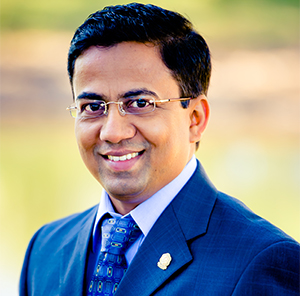 Raju Nagaiah, Ph.D., is a Licensing Associate in University of Central Florida’s Office of Technology Transfer (OTT). He holds two master’s degrees—in Mechanical Engineering and in Industrial Engineering—and a doctorate in Industrial Engineering from UCF.
He joined OTT in 2012 and works with faculty, students, and industry partners within the physical sciences.
Much of Nagaiah’s work is centered on reaching out and creating connections with people inside and outside of the university. When it comes to reaching out to faculty, Nagaiah may have several reasons for doing so. “Sometimes, I reach out to faculty of a particular research interest if I find a relevant funding opportunity. I reach out to them if we have identified a potential licensee who would like to know more about their technology,” he said.
The licensing process begins when a faculty member discloses their invention to OTT. Nagaiah said that he uses this opportunity to meet with them to learn more about the disclosed technology as well as their research. “At the same time, I use that opportunity to explain our role and how they can benefit from our office,” he explained.
Nagaiah’s day-to-day activities also involve coordinating the inflow and outflow of communication. “Throughout the day, I coordinate with General Counsel, as well as with clients about licensing agreements, option agreements, or inter-institutional agreements.” Potential licensees may request to visit a faculty’s lab to further understand the technology. Nagaiah coordinates the permissions of these visits, where a confidentiality disclosure agreement (CDA) or non-disclosure agreement (NDA) will be needed so that the researcher can discuss the patent pending technology.
Nagaiah finds that certain challenges can crop up in the licensing experience, mainly the navigation of the steep learning curve of how the licensing process works. “When working with start-ups or small companies, in the beginning of our relationship, we provide a lot of assistance and guidance,” he noted. As both inventors and industry partners work together with OTT, both parties become more independent with their gained knowledge and experience.
In terms of his most successful licensing experience, Nagaiah mentioned Helicon Chemical Company, a student-led startup based in Orlando, Florida from Pegasus Professor and UCF Distinguished Professor Sudipta Seal, Ph.D.’s lab. This startup’s technology is centered on improving the burn rate of solid propellants used in rockets and missiles through the use of nanotechnology. What makes this experience unique and successful is that the company is founded by the student who helped to develop the technology, wrote his dissertation on the technology, and is now commercializing the technology. Additionally, Nagaiah himself was able to learn many things about this area of nanotechnology through the licensing process.
For researchers interested in disclosing their technologies to OTT, Nagaiah had this to say: “Researchers work on complex problems, like cures for cancer, efforts toward energy independence, or solving transportation problems—these are all good and worthwhile things to research, but they require a lot of infrastructure and R&D effort in order to take the invention from the concept stage to the market stage. But the day-to-day problems of consumers, where the product costs less than five to ten dollars—these sorts of solutions can be taken to market with little cost. They would be very easy to license, and it’d be easy for anyone who wants to license the product to take it to the next level.” Most of the technologies OTT manages are complex and require strong partnerships for successful research, development, and commercialization.
For entrepreneurs interested in taking ideas to the marketplace as licensees, Nagaiah remarked that the ideal entrepreneurs are able to “think things through. They have researched what a particular technology can do. The licensee needs to know what kind of network and investors are needed. They need months of due diligence before starting the licensing process.” This due diligence is to ensure the long-term success of product development and commercialization.
In order to have a healthy, beneficial licensee/licensor relationship, Nagaiah said that timely communication is key, as well as continued guidance and support. “Providing the right communication and connecting the licensee with the right people can help to develop a good relationship with the licensee. Once the technology is licensed, we connect them to business development groups such as UCF’s Venture Accelerator Lab or Business Incubation Program.”
Overall, Nagaiah enjoys his job at OTT. “The job we do is challenging because licensing associates must have a technical edge, a legal edge, as well as a business edge. A licensing associate has to coordinate with people from all three areas, as well as with colleagues, faculty, students, and clients.” All that effective coordination and communication results in forming relationships that bridge the research lab and the marketplace and impact our world.
If you’re interested in disclosing your UCF invention or licensing UCF technology, contact Raju Nagaiah to get the conversation started.
Written by Deborah Beckwin
The AutoNation Cure Bowl Makes a Play for a Cure for Breast Cancer
October 1, 2015
 College football season is back, and so is Breast Cancer Awareness Month. What do these two seemingly unrelated things have in common? The AutoNation Cure Bowl! In collaboration with Florida Hospital, the presenting sponsor, the AutoNation Cure Bowl will be held on December 19th at the Orlando Citrus Bowl. Proceeds from the game will go to the Breast Cancer Research Foundation (BCRF). The Cure Bowl was announced this past summer by Annette Khaled, Ph.D., Associate Professor at the Burnett School of Biomedical Sciences in the College of Medicine at UCF, Dr. Lori Boardman, medical director of Florida Hospital for Women, and Orlando Mayor Buddy Dyer.
According to UCF Today, BCRF received the only A+ rating from CharityWatch for a cancer organization. BCRF has low overhead and spends 91 cents of every dollar it receives for breast cancer research. Khaled recently received a $250,000 grant from BCRF, and this funding will go toward her research of metastatic breast cancer. There will be over 231,000 new cases of invasive breast cancer this year alone, and since breast cancer can recur and become metastatic, Khaled’s research is a crucial link in finding a cure.
Khaled became involved in the Cure Bowl through the UCF Foundation News, a quarterly newsletter. She had received funding from the Florida Breast Cancer Foundation and was profiled as the “Cancer Assassin” by the newsletter. Alan Gooch, executive director of the AutoNation Cure Bowl and CEO of the Orlando Sports Foundation, was reading through and discovered her. “He was trying to figure out how to make the Cure Bowl happen and involve some local cancer researchers. But they couldn’t find any cancer researchers that would be able to be funded by the BCRF. Then he opens up the newsletter, and there I am.”
One feature of the Cure Bowl will be the Cure Village, hosted by Florida Hospital. Women will be able to receive mammograms and other types of screenings. “In Orlando alone, over 50 percent of women are not getting their mammograms,” Boardman told the Orlando Sentinel. “We hope this game will inspire fans to get mammograms and to encourage friends and family to do the same.” Florida Hospital also collaborates with Khaled’s research, providing her with tissue samples from breast cancer patients.
For football fans interested in the game, teams from the American Athletic Conference (UCF’s conference) and the Sunbelt Conference will tentatively be selected on Sunday, December 6th, and kickoff will be at 7pm on December 19th. For those that can’t come to the Orlando Citrus Bowl to see the action live, this game will be broadcasted on CBS Sports Network. Visit curebowl.com for more information.
—
Khaled is also profiled in this month’s Faculty Feature, where you can read more about her and her latest research endeavors. Her innovative treatment for metastatic breast cancer is available for licensing. Contact Brion Berman for more information on how to partner with UCF to bring this treatment to market.
From Idea to Marketplace: Researchers, Finding a Licensee to Bring Your Ideas to Fruition
September 23, 2015
Part 2 of 3-part series explaining the process of licensing technology
 Two weeks ago, we went over the journey for bringing innovations from the lab to the marketplace is rigorous, and each step is carefully and thoughtfully examined. This week, we are going to focus on how the Office of Technology Transfer (OTT) can help identify a licensee to bring your discoveries to market by connecting you, the researcher, and your innovations with companies and entrepreneurs.
Identifying a Licensee
Once we have begun the patent protection process, our team begins the search for potential partners to license your innovation and incorporate it into an existing product or create a new product, known as commercialization. Depending on the invention, its potential market, and stage of development, it may be licensed to an existing company or a startup company may be formed. Most of the time, through your own working relationships, you as a researcher will know the companies most interested in your research and resulting innovations.
Marketing Summaries are found on our Technology Locator webpage, where industry partners and technology scouts can look up the tech field, technology, or the researcher name for the latest technologies available for licensing. We also showcase innovations at regional and national conferences. Most recently, we attended the TechConnect World Innovation Conference & Expo, where we showcased UCF innovations and met with industry partners from across the world.
Although OTT widely markets your patent pending and patented inventions, we encourage you to also be a partner of the marketing process. As previously stated, many potential licensees arise from the relationships that you have made. Your publications and presentations are also effective marketing tools.
The amount of time it takes to find a licensee depends on a number of variables, including the stage of development your invention is in, how in demand it is, what the competition looks like, and the size and intensity of your corner of the market. OTT takes all of these variables into consideration, even before you get to the commercialization stage. We want to ensure that your work is as successful as it can be. Depending on the stage of development, your invention can take a large amount of capital to get it ready for market. Sometimes, even more research and additional funding can be birthed from this development process.
The License Agreement
In order to successfully create a bridge for your invention from the lab to the marketplace, the licensing associate is your guide and advocate. Once a company has elected to license your innovation, a licensing agreement is drawn up, citing the rights and responsibilities that relate to how it will be commercialized, namely for the public good. Additionally, product development milestones are set and the licensing associate monitors the milestones and sales of your invention.
The commercialization of your innovation typically results in revenue—the license fees and royalties calculated with a standard royalty rate of the net wholesale generated by your invention. We discuss the royalty distribution more in detail here. The revenue not only goes to you, but back into UCF for further advancement of research and education.
—
As America’s Partnership University™, we value our partnership with you as well as the partnerships we make in the private sector. When you partner with OTT, you can focus more on your passion for research and teaching, and we can focus on the administrative work that enables bringing your hard work to fruition and to market. Contact us today and let’s start a partnership for the greater good.
In two weeks, we’ll talk about how we work with industry partners to bring your work to the private sector, which enables your work to be even more relevant and more accessible to the public at large.