This St. Patty’s Day, Share a Shout-out About Green CO2-Reducing Clean Fuel Technology
 Tech Blog Thursday is an original monthly blog series that mixes serious science with humor and easily recognizable analogies for the less-than-scientifically inclined. The purpose of this blog series is to illustrate the potential of not-yet-commercialized technology and encourage excitement about the possibilities.
March 5, 2015
If you’re not green on March 17th, watch out for pinchers!
According to an American tradition, wearing green would render you invisible to leprechauns on the prowl to pinch anyone they could see. If you weren’t wearing green, you got pinched!
The greener you are, the safer you’ll be. The same holds true in the real world.
Let everyone know how green you are by sharing the news about a method to produce 99.99% pure hydrogen gas with reduced or eliminated CO2 emissions, a major greenhouse gas that contributes to global warming. The patented technology gives hydrogen a major boost to help beat fossil fuels as the leading source of energy. We’re still a long way from a full energy revolution, but regular ol’ oil will take a big hit when this new process for producing hydrogen with less energy, fewer expensive materials, and without CO2 emissions is commercialized.
Hydrogen is a promising alternative to current energy sources such as fossil fuels. Like most forms of alternative energy, hydrogen has a lot of potential once barriers such as the high energy and expensive material requirements of its conventional processing are overcome. With the new technology developed at UCF, hydrogen fuel made without the drawbacks of other methods gets ready to take on—and take down—fossil fuels.
Hydrogen is used as the fuel for the space program, to power fuel-cell driven cars, and to generate electricity because of its remarkably efficient conversion rate. It’s non-toxic and produces only water as a byproduct when used in fuel cells.
Hyrdogen must first be produced to be used as an ecologically clean fuel. The hydrogen producing method developed by UCF can use hydrocarbon feedstocks, including sub-quality natural gas, biogas, allowing it to take advantage of less-refined fuels like those containing sulfur, which are often less expensive. This means hydrogen can be produced at a lower cost compared to conventional methods. Less-expensively produced hydrogen can be sold for less, encouraging the development and growth of technologies that use this zero-emission fuel.
The process also creates a carbon value-added byproduct that can be used as a structural material, which can be sold to offset the cost of hydrogen production, making the fuel even more attractive to industry.
By using an inexpensive material, carbon generated from methane, as the catalyst, the process skips a regeneration step required by other methods. Since no oxidant is involved in the process, CO2 emissions are significantly reduced or eliminated.
This year, make sure you’re truly green on St. Patrick’s Day. Here at the UCF Office of Technology Transfer, we’re getting the word out about technologies like this and others that can change the world for the better when they become licensed and commercialized.
For more information about partnering with UCF to bring this technology to market, contact Raju Nagaiah.
The Perfect Valentine’s Day Gift: High Power Mirror for Laser Filamentation
Tech Blog Thursday mixes serious science with humor and easily recognizable analogies for the less-than-scientifically inclined. The purpose of this blog series is to illustrate the potential of not-yet-commercialized technology and encourage excitement about the possibilities.
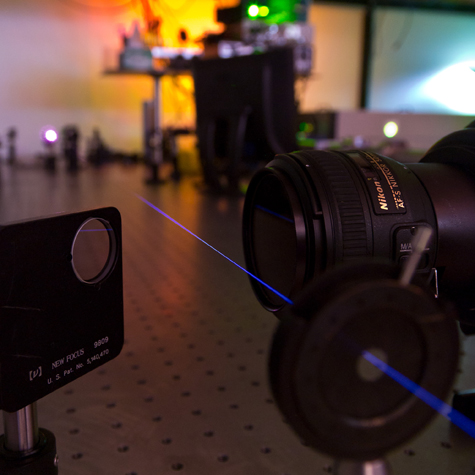
A long-exposure photograph of the plasma emission that results during filamentation. Within a dark laboratory, the filament emission was visible to the dark adapted eye—detection primarily by the rods of the human eye and not the cones. The blue color was characteristic of molecular nitrogen emission bands in the 300 nm to 400 nm spectral region.
February 5, 2015
UCF Tech Transfer wants to help you pick the perfect gift for your special someone this Valentine’s Day.
On February 14th, they will be expecting a gift that shows how much you care, how well you know them, and the expectations you have of your future together. You need something enduring, and your special someone deserves the very best.
The gift can’t be what everyone else has, but you wouldn’t want to chase trends either. It should be the best of both worlds: a twist on a classic. It should be strong and made to last, and shine so brilliantly it is impossible to ignore. Your gift should reflect everything you cherish about your loved one, and incorporate noble metals and gems.
What you need is a high-power mirror for laser filamentation.
Laser filamentation, the nonlinear optics phenomenon of self-focusing and propagation of a beam, requires a pulse of high-peak-power laser radiation that exceeds the damage threshold of conventional laser mirrors. The new mirror can surpass the damage threshold of conventional mirrors because of its composition, a 500 nm-thick layer of 99.99999% pure gold deposited on a smooth sapphire substrate. Gold, among other noble metals, possesses qualities that allow energy to be more evenly distributed so that energy per unit area doesn’t exceed the material damage threshold.
Your sweetheart will connect the dots in an instant when you show that your love for them that keeps you focused is so powerful it needs a next-generation, patent-pending high-power laser mirror.
This high-power laser mirror is even more attractive when you consider its simplicity to manufacture—relative simplicity, we don’t recommend building it yourself—and versatility beyond laser filamentation, for all of your other high-power laser beam redirection needs.
To learn more about partnering with UCF to bring this innovation to market, contact John Miner.
Gold-black Coating: Great for UCF Knights and for Night Vision
Gold-black Coating: Great for UCF Knights and for Night Vision
Tech Blog Thursday mixes serious science with humor and easily recognizable analogies for the less-than-scientifically inclined. The purpose of this blog series is to illustrate the potential of not-yet-commercialized technology and encourage excitement about the possibilities.
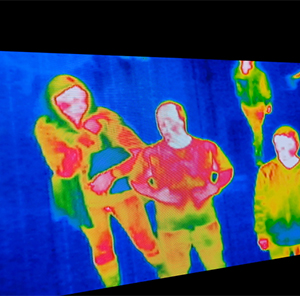
Figure 1: Thermal Image. UCF researchers developed a method of applying gold-black coating to bolometers for better production and performance, resulting in improved thermal images.
January 8, 2015
Gold.
Black.
Coatings.
To a nontechnical audience, these words might bring to mind sweatshirts and jackets available at the UCF bookstore, but a new technology available for licensing takes gold-black coating to another level. UCF researchers have developed a novel method for applying gold-black absorptive coating for use in thermal infrared (IR) sensors (also known as bolometers), which are used in space imaging and night vision.
Gold-black is a nanocrystalline deposit formed when an inert gas causes gold atoms to collide and bind with each other to form a weblike structure. This coating, when applied to the thermal sensing elements of IR array detectors (that is, many detectors arranged in rows and columns), improves the absorption of IR radiation, which translates to heat. In the case of IR array detectors used in night vision applications, the higher the percentage of IR radiation absorbed, the more a person can “see” in the dark because of the differences in the heat radiated from objects, people and the surrounding environment (see Figure 1).
The patent-pending technology at UCF, a faster and more effective method of applying absorptive gold-black coating to IR array detectors, has many benefits.
With the new application method, the absorptive coating covers more thoroughly and stays on better over time compared to previously available methods. It’s the difference between a shoddy coat, one with holes that expose your arms to cold air and made with thin thread that comes more undone with every wash, compared to a well-constructed coat that covers you well and maintains its quality over time. The new coating method prevents delamination, a process where coatings flake off like a bad paint job. For your coat or a coating, it’s important to have good coverage that lasts.
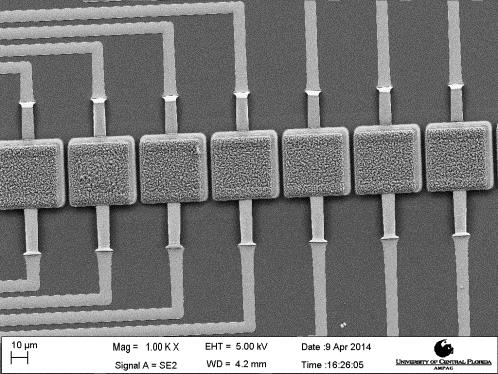
Figure 2: Gold-black patterned on sensing pixels of IR sensors to convert IR radiation into temperature change (heat).
The new method also applies the coating selectively, which saves production time and cost. By only coating the thermal sensing pixels of the IR array detectors and avoiding the non-sensing spaces in between, the time-consuming step of removing the extra material, called laser ablation, can be cut out of the production process. As a comparison, imagine if every coat was first made as a full-body suit with no holes in it for you to pull it on, see out of it or breathe well. Imagine that these coats had to have holes cut in them by hand, slowly and painstakingly. In this case, a way to easily make a coat that you could pull on and have places for your arms and neck would be in high demand.
The better gold-black coating coverage has realized at least 90 percent absorption of infrared radiation, but more often approaches 100 percent. This improved absorption results in a better IR image for applications that use this coating.
While gold-black coating is most useful for military endeavors and space-related imaging, you can sport your Knight pride by wearing gold and black coatings of a different sort.
To learn more about partnering with UCF to bring this technology to market, contact Raju Nagaiah.