What to Remember About November, Movember, and No-Shave November
Tech Blog Thursday mixes serious science with humor and easily recognizable analogies for the less-than-scientifically-inclined. The purpose of this blog series is to illustrate the potential of not-yet-commercialized technology and encourage excitement about the possibilities.
December 3, 2014
 Reflecting on Movember, or No-Shave November, a month where guys can forgo their normal face-shaving routine in the name of men’s health, it’s time now to even the score of how many scruffy faces you’ve encountered versus how much you’ve heard about the cause.
A combination of “moustasche” and “November” in the case of Movember, the month has become known as a time for men, or “mo bros,” to change the face of men’s health by growing their facial hair to raise awareness of men’s health issues such as prostate cancer. Posting pictures of a proudly-perfected beard or moustache can serve as starting points for men encouraging each other to talk about the importance of annual check-ups and awareness of family cancer history.
Now that you or the mo bros in your life just said goodbye to a month of gardening around grins and said hello to Gillette, read up on the real cause with help from a couple of history’s famous bearded manly men.
“Man is not made for defeat.”
—Ernest Hemingway
The kind of guy who survived two plane crashes on consecutive days and fought off sharks with a machine gun, Ernest Hemingway was a man’s man. In step with his reputation for directness, here’s the quick-and-dirty rundown on a main defense against prostate cancer.
- Androgens are male hormones, including testosterone, produced primarily by the testicles
- Androgens stimulate the growth of prostate cancer cells
- Androgen blockade therapy lowers androgen levels or stops them from getting to prostate cancer cells
- Less exposure to androgens can make prostate cancer shrink or grow more slowly
But androgen blockade therapy doesn’t work forever. Eventually, this reduced level of male hormones leads to an increase of androgen-independent cells and the development of prostate cancer able to grow without the presence of androgens.
“The art of war is simple enough. Find out where your enemy is. Get at him as soon as you can. Strike him as hard as you can, and keep moving on.”
—Ulysses S. Grant
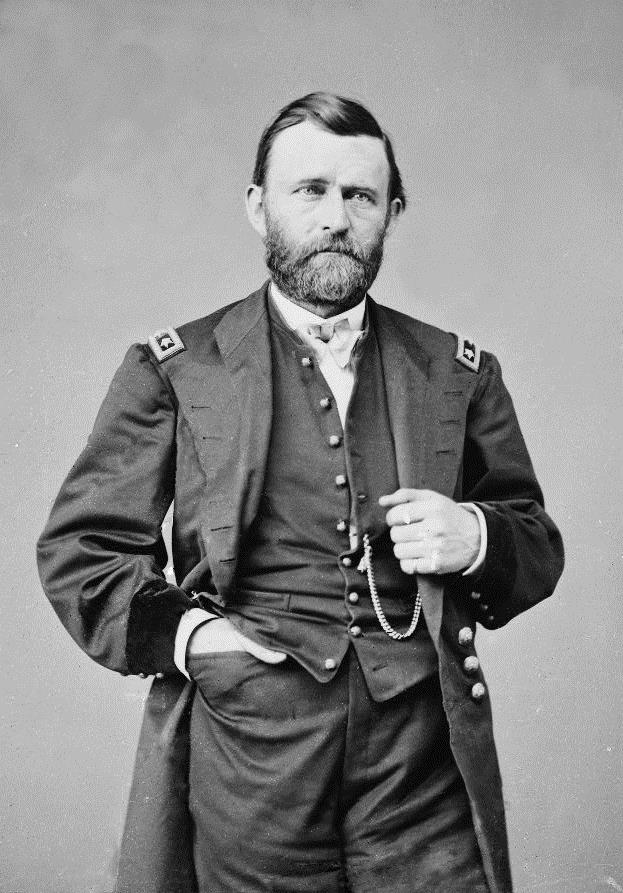
Ulysses S. Grant
Grant knew how to win a fight. Commanding general of the Union armies as a West Point graduate, Grant led them to victory over Confederate forces and went on to win two terms as the 18th President of the United States.
Researchers at UCF know how to win a fight too. In the spirit of Grant’s strategy, they’ve now identified a specific cluster of micro RNA (miRNAs) involved in prostate cancer’s transition from a form that can be slowed or stopped by androgen blockade therapy to prostate cancer that grows just as much without the presence of androgens. UCF researchers patented the newly-discovered miRNAs that can now be developed into biomarkers and therapeutic targets for prostate cancer.
We’re challenging all mo bros to step up and talk boldly about men’s health. Here at the UCF Office of Technology Transfer, partnering with others is the only way we can bring vital technology like a prognostic marker for aggressive prostate cancer out of the labs and into the real world, where it can help brave men fighting for their lives. Make the patchy phase you or your mo bro survived worth it by starting a conversation about the steps men can take to increase early cancer detection and ultimately reduce the number of preventable deaths.
To learn more about partnering with UCF to bring this prognostic marker for aggressive prostate cancer to market, contact Brion Berman.
(Update: the technology referenced here is no longer available for license. However, if you are interested in partnering with the research team for future projects, contact Brion Berman.)
Paralyzing Breast Cancer, Stopping Metastasis in its Tracks
Tech Blog Thursday mixes serious science with humor and easily recognizable analogies for the less-than-scientifically-inclined. The purpose of this blog series is to illustrate the potential of not-yet-commercialized technology and encourage excitement about the possibilities.
October 17, 2014
Dear Cancer, I hope one day you are just a zodiac sign. 
–Anonymous
For many breast cancer patients and survivors, cancer recurrence and metastasis, the spreading of the cancer to other sites, are constant concerns. In fact, an estimated 90% of breast cancer- related deaths are due to metastasis. Once they break away from the original tumor, metastatic breast cancer cells can spread to other parts of the body, and in particular, the bone, brain, liver, and lung. Cell movement represents a significant challenge for cancer researchers and oncologists; and currently, there is no cure for metastatic (stage IV) breast cancer. For these patients, treatment options are typically limited to systemic “whole body” therapies such as chemotherapy, which can have toxic side effects on healthy cells.
Cancer metastasis is a complex process which requires significant rearrangement of a cellular support structure known as the cytoskeleton (an intricate network of filaments akin to the skeletal system, but less rigid and more dynamic). Because of its critical role in cell movement, the cytoskeleton has become a target for many cancer drugs in development. Widespread use of these drugs, however, is limited by their high toxicity. At the UCF College of Medicine’s Burnett School of Biomedical Sciences, Dr. Annette Khaled and her research team are developing a new anti-cancer compound called CT20p. CT20p specifically disrupts the cytoskeleton of breast cancer cells, without harming healthy cells. In response to treatment with CT20p, breast cancer cells detach from their surroundings, round up, stop moving, and die – similarly to what would happen if we suddenly lost the structure and support provided by our bones.
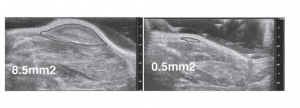
Breast cancer tumors were implanted in mice. CT20p treatment caused tumor regression (right figure).
To safely deliver CT20p to the target cancer cells, CT20p is encapsulated in a specialized nanoparticle developed by Dr. J. Manuel Perez at the UCF NanoScience Technology Center. The surfaces of the nanoparticles contain ligands that specifically bind to cancer cells, concentrating the CT20p at those target sites. As proof of concept, injection of the CT20p-nanoparticle complex into a breast cancer mouse model caused significant tumor regression and did not damage the liver or the spleen, two sites where untargeted nanoparticles could accumulate. The complex is currently being tested with human breast cancer samples.
“Our goal is to develop CT20p into a powerful cancer therapeutic to kill the most invasive types of breast cancer cells that are responsible for cancer recurrence and metastasis. Successful completion of our work will have a significant impact on the survivability of metastatic breast cancer patients,” says Dr. Khaled.
As a new therapeutic, CT20p could be used to treat early-stage breast cancer as well as advanced metastatic breast cancer, the fatal form of the disease. For all breast cancer patients, our hope is that, one day, we will be able to stop cancer dead in its tracks.
Learn more about partnering with UCF to bring this breast cancer therapeutic to market, contact Brion Berman.
>>Guest blog post by Christina Kittipatarin, Ph.D.
Textbook Triumph – Electronic Book Operating System
Tech Blog Thursday mixes serious science with humor and easily recognizable analogies for the less-than-scientifically-inclined. The purpose of this blog series is to illustrate the potential of not-yet-commercialized technology and encourage excitement about the possibilities.
October 9, 2014
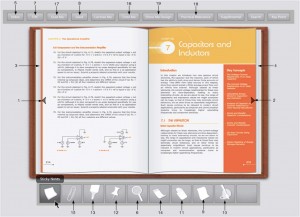
eBook OS – Architecture Design
Sometimes, a teaching assistant is all a student can turn to in the quest for gold—a good grade in a tough course. A bona fide professor is ideal, but it can be challenging for them to have enough time to speak with all of their students one-on-one.
As an archaeology student in a class taught by Dr. Henry Jones, you might have heard from students who’ve taken his classes before that he’s rarely there. But the other option for the required credits isn’t much better; River Song has issues with time management too.
If you’re interested in Genetics, the class taught by Professor Xavier is well-reviewed on RateMyProfessor.com, that is, if he’s not busy with political business.
Students with a mind for technical subjects who sign up for Transfiguration with Professor Dumbledore (often away from campus for “important business”) have said he seems better-suited for an administrative role.
Word on the street says taking Paleontology with Dr. Ross Geller is a bad decision. He’s always at a coffee shop in Manhattan, talking with his friends and often talking about “a break.”
Professor Plum spends a suspicious amount of time in the library, and Professor Abraham Van Helsing didn’t prioritize his teaching time either.
In cases like these, a TA often steps in and does their best to teach the material like the professor would, but they may only be a small step ahead of the students they need to teach, and buried under a mountain of their own studying to do as a graduate student.
Take heart, overworked teaching assistants! There’s a new, patented textbook that’s going to take care of everything for you. The technology, from your friendly neighborhood UCF, is a student-instructor learning environment that simplifies technical concepts and learning material with immediate answers to complex equations, a learning environment that engineering and science students can also use as a design tool.
The new electronic book operating system, eBOS, looks and functions like a printed book through flipped pages, bookmarks, highlighting, and notes. The technology is hardware-independent and cross-platform capable.
The “real book” look of eBOS can encourage students to use their textbook, and the advanced features mean material can be adapted based on difficulty levels and solution methods.
Students won’t have to bother the stressed TA when their textbook has advanced search functions that support wildcard characters, returning results that can be saved in a customizable index for future reference. The content structure is also personalized through a customizable table of contents.
Where students might otherwise email the TA at 3am for clarification, eBOS-equipped students can activate the TutorMe feature when concepts are hard to grasp at first.
More built-in modules like LectureMe, ShowMeDesign, Practical Relevance, and QuizMe bridge the gap between student and instructor. The eBOS system is ideal for science, technology, engineering, and mathematics instruction with its ability to solve an infinite number of problem variations to complex equations. The instructor can input different variables to seed new problems for students to solve within the eBOS learning environment.
The QuizMe feature opens an interactive test on any section and chapter of a book, the TutorMe feature guides a student through the lesson with additional teaching materials on any section and chapter, and LectureMe can open an instructor’s recorded lecture within the textbook. Students can learn to apply the material by referencing ShowMeDesign and Practical Relevance, retaining knowledge for use outside of classroom walls.
The eBOS innovation could save TAs and students if a professor is out saving the world, and help students everywhere learn material in a more practical and interactive way, but it can’t happen until the technology is commercialized.
For more information on taking this technology to market, contact Raju Nagaiah.