Flash Forward Friday: Cleaning Up Oil Spills with Eco-friendly Fly Ash
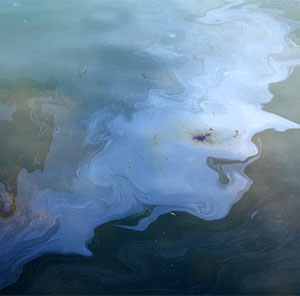
Water Contaminated by an Oil Spill
Flash Forward Friday is a feature of the UCF Technology Transfer blog, “Patent Trending,” where we theorize a future where a specific UCF technology has been commercialized and is changing the way our future selves live, work, and play. The purpose of this blog series is to illustrate the potential of not-yet-commercialized technology and encourage excitement about the possibilities.
August 29, 2014
In 1989, the Exxon Valdez spilled more than ten million gallons of oil into the Prince William Sound in what’s considered to be one of the most devastating human-caused environmental disasters.
In 2010, British Petroleum (BP) spilled 4.9 million barrels of crude oil into the Gulf of Mexico.
Typical cleanup efforts in the wake of an oil spill include:
- Physical containment with barriers that keep a spill from spreading so it can be skimmed or vacuumed up, which would be great if water didn’t move so much or if Dyson expanded their line of vacuums.
- Dispersing the oil with chemicals that break surface oil slick down into smaller droplets that more readily mix with the water, which would be great if nothing lived in the ocean, especially nothing we ate… like fish. Dispersants create a toxic environment in the ocean by releasing harmful oil breakdown products into the water, potentially causing more harm to marine life than untreated oil.
- Raking and bulldozing shorelines to uncover sunken pools of oil that seep into surrounding ecosystems over time, which would be great if fragile dunes were the tough guy among eco systems—but they’re far from it.
- Sopping oil up with sorbents like Bounty paper towels and ShamWows which would be great if there were an overwhelming supply of a non-toxic sorbent that leaves the soaked-up oil still useful as fuel.
Do you see where we’re going with this one?
Functionalized Fly Ash: A Recyclable Sorbent for Oil Spill Clean-up and Energy Recovery
Flash forward to 2020. An oil tanker runs aground and spills millions of gallons of fuel that threatens to ruin a beautiful reef nearby. In the years before researchers invented a way to functionalize fly ash to clean up oil spills and recover the oil as usable fuel, a spill like this would have dominated the front page of every newspaper and the feeds of every 24-hour television news network. But in 2020, the spill is handled quickly and effectively by companies that produce the patented functionalized fly ash, only making page 16, but making billions of dollars for those who capitalized on the solution to two eco-problems of the past.
Several years earlier, scientists at UCF put their heads together to think of a practical solution for oil spill clean-up efforts. The world at large needed better materials to soak up oil, removing it from water and coast lines. In 2020, these accidents are readily treated, using a transformed waste product, to remove oil from delicate oceanic and coastal ecosystems and reuse it as fuel.
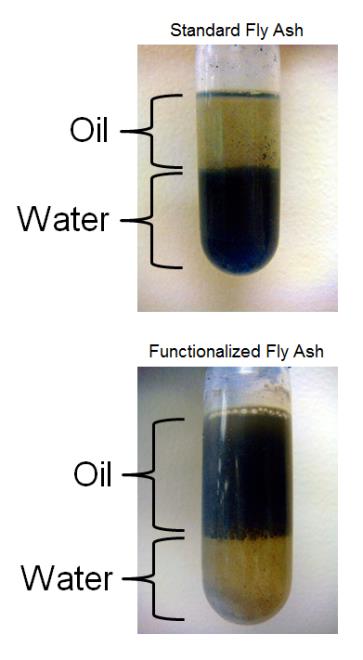
Because standard fly ash is hydrophilic (water-loving), its ability to soak up oil is hampered by the water it soaks up first and more easily. In contrast, the functionalized fly ash has a hydrophobic (water-repelling) nature that allows it to absorb oil more readily than water.
In the time before functionalized fly ash became the de rigueur solution, materials typically considered for oil spill cleanup included natural materials like straw, clay and volcanic ash (materials with a good capacity for soaking up oil, but not much compatibility with water) and synthetic materials like polypropylene and rubbers (materials compatible with water, but expensive).
Meanwhile, fly ash, a residue generated when burning coal for fuel, was considered waste material with little productive usage, especially in developing countries. Millions of tons were dumped in landfills yearly. In 2008, in the United States alone, about 131 million tons of fly ash were produced annually by 460 coal-fired power plants.
When this now-valuable fly ash was considered a waste material, it was often stored in wet ponds that minimized dust. The ash would leach toxic metals over time like lead and arsenic, contaminating groundwater. While fly ash containments were typically stable, accidental breaches were rapid and on a massive scale, causing problems similar to oil spills.
While regular old Joe-Schmoe fly ash is a poor oil sorbent with its low porosity and hydrophilic nature—having the same effect as trying to clean up orange juice with a wet paper towel instead of a dry one, where the capacity to soak up a mess is impeded by what it’s already absorbed—the two-step approach developed by the game-changing researchers at UCF increases the surface area of fly ash particles and functionalizes the surface to create a porous hydrophobic material.
Changing the environmental consequences of future oil spills from a front-page crisis into no-big-deal, we’ve-got-it-handled news on page 16 relies on the commercialization of technology like this. Without the investment of companies willing to plan ahead and prevent environmental catastrophes caused by oil spills, we’ll look back in 2020 with 20/20 hindsight that someone should have acted in 2014.
For more information on partnering with UCF to bring this technology to market, contact Andrea Adkins.
Detect Free Radicals with Nanoceria
Tech Blog Thursdays mixes serious science with humor and easily recognizable analogies for the less-than-scientifically-inclined. The purpose of this blog series is to illustrate the potential of not-yet-commercialized technology and encourage excitement about the possibilities.
July 15, 2014
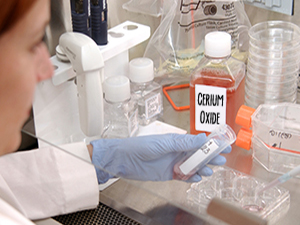
Meet nanoceria.
Another name for nano-sized particles of cerium oxide, nanoceria is a reactive oxygen species (ROS) scavenger, a very good thing. And so, nanoceria can be used to help treat a myriad of maladies— including cancer chemotherapy, transplants or prosthetic devices, and ailments with a pro-inflammatory component, such as Crohn’s disease, inflammatory bowel disease, arthritis, multiple sclerosis, and Alzheimer’s.
The kicker? Nanoceria is toxic to the human body, and we’ve only gazed longingly at it until now.
Why Scavenge Reactive Oxygen Species (ROS)?
Better known as free radicals, ROS can serve as a part of happy, healthy human functioning, formed as a natural byproduct of the normal metabolism of oxygen, with important roles in cell signaling and homeostasis. But these cute little molecules become raging hordes of wildcards when they are increased in number by environmental stress.
Free radicals increase oxidative stress, a normal process of aging and degeneration that’s like a rusting pipe. You are the pipe, and you live in a world where you’re going to eventually rust.
But that process has a lot to do with your environment. Put the pipe in a rainy corner of your backyard and it’s going to rust – be affected by the process of oxidation – more quickly. Put a sliced apple in the fridge and it will brown a little; put it on a counter and it will brown more quickly. The same thing happens when our environment promotes more free radicals (those pesky reactive oxygen species) than our body can fight well. Increased and prolonged exposure to the wild and reckless free radicals can cause a build-up of “rust” in the form of diseases caused by oxidative damage in our bodies.
What ROS Has To Do With Disease
An increase in reactive oxygen species doesn’t happen exclusively as an aging process.
Think of your car. You see the mileage going up, slowly but surely, as you drive through town to work or school, running errands, and back home again. You know your car will eventually go belly up from all of this use, but it could be long after you’ve Velveteen Rabbited it with love—when its dents and scrapes are signs of adventures and misadventures over the course of many years.
That’s the smooth road of oxidative stress and damage, courtesy of free radicals.
Take a cross-country road trip and the same everyday wear-and-tear is concentrated, shaking out a little more of your car’s sand-in-the-top-of-the-hourglass than you’re used to seeing in a shorter period of time.
That’s oxidative damage when we experience more environmental stress.
But when your car experiences an unfortunate slip on asphalt and slams into another car as you’re driving down the highway in the rain, and you find yourself in a six-car pileup—that’s oxidative damage from inflammation caused by bigger health issues.
The bumps and scrapes are evidence of a relative car-tastrophe, and to your body, evidence of inflammation that comes with health issues like cancer chemotherapy, transplants or prosthetic devices, Crohn’s disease, inflammatory bowel disease, arthritis, multiple sclerosis, and Alzheimer’s.
What’s your next step after a big accident, when you want to get your car fixed? You take it to a shop to get an estimate of the damage. Someone reports all of what’s wrong to your insurance company by giving an account of what’s wrong with your car, where the problem is, and what it’s going to take to fix it.
In this analogy, the unfortunate crash is a health issue, bumps and scrapes are evidence like free radicals, and a doctor is the insurance company. In order to fix the damage, nanoceria can report, like a mechanic or a body shop would, where the damage is.
Nanoceria Doesn’t Play Nice
The human body is highly adaptable—to a point. But introducing something it’s not intended to handle won’t have good results. In the same way that metals like lead and mercury are toxic, nanoceria is toxic because the human body has no mechanisms to moderate it or to get rid of it.
Using a tarantula to fix an insect problem by letting it loose in your house would be technically effective, but not very good for you overall. If, however, you could put the tarantula in a hamster ball and let it roam about without being a danger to everything else living in the house, there’s a way to make its nature work for your benefit.
While nanoceria doesn’t battle reactive oxygen species—but rather, alert us to its presence and concentration—our ability to use it for the detection of reactive oxygen species hinges on making it safe for the human body as a whole unit.
UCF researchers have developed a technology that encapsulates nanoceria, hamster-ball style, in a nano-sized unit that pairs it with an imaging component. The nanoceria on its own can scavenge reactive oxygen species, but it’s the combination of nanoceria with a way to observe its talent show performance that makes for a medical treatment we can use.
The unit is comprised of two separate compartments, each externally permeable, one containing nanoceria, and one containing a flourophore (light-up) imaging agent. Nanoceria, when in the presence of excess ROS, affects the flourophore by changing its level of fluorescence emission, or another change observable with tests like MRI or with X-ray contrast. This change, like hitting a button on your car key chain in a parking lot to remember where you left it by following the sound of the beep, is how a doctor can use the device to find areas of damage indicated by free radicals from inflammation in order to treat a patient.
For more information on partnering with UCF to bring this technology to market, contact Andrea Adkins.